
An introduction is a door, not a delivery. The person walking through it decides what it’s worth.
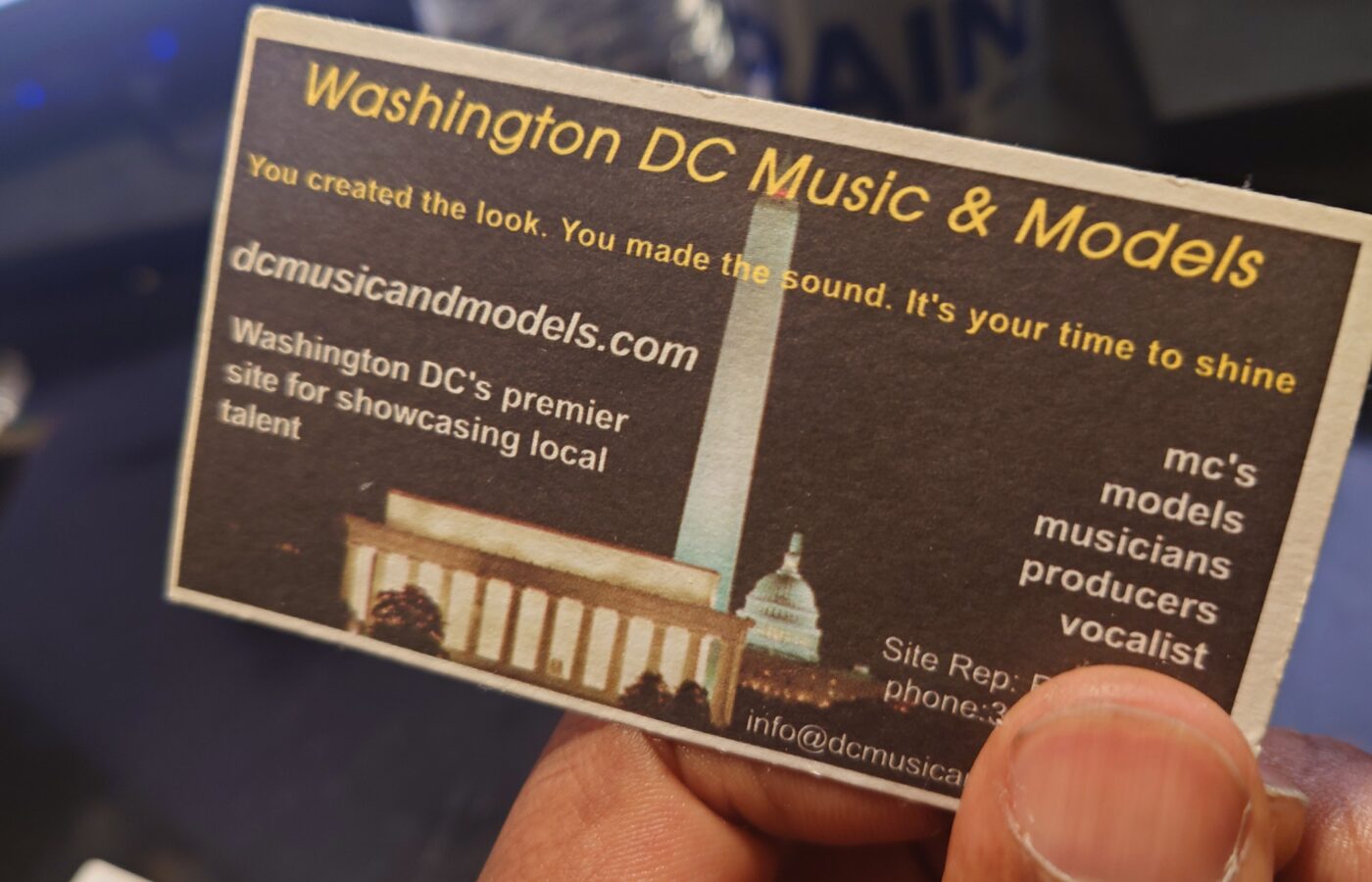
Featured image: the first DC Music & Models business card, circa 2003.
The first person who ever opened a door for me was a DJ whose name I can’t remember. My uncle Daryl introduced us. They were cousins, and I was in the earliest stretch of building DC Music and Models, a period when the whole company was a website and an idea.
He didn’t have to do anything for me. He did it anyway. He told me about the record pool meetings running in the DC area at the time, the Unruly Record Pool, and he got me in the door. He introduced me to a couple of DJs whose names people in the city already knew. Then he handed me the phone number of someone at a record label, a person with enough standing that an independent deal wasn’t out of the question if the conversation went right.
I made the calls. I sat in the meetings. I got in front of the label contact and I talked. Nothing came of it, and the reason nothing came of it was me. I didn’t have the product yet. I didn’t have the words. I couldn’t describe what I was building in a way that made a person with real options want to spend some of them on me. The door was open and I walked through it without proof, only a small concept. Nothing anyone could see.
That’s not the part that bugs me. I’ve been thinking about the other side of that door.
What changed when I stopped seeking
Two short years later, DCMM Live TV was airing a few times a week on Comcast leased access in Washington, DC and Prince George’s County, Maryland. My website and TV show were poppin’, and news of the show spread throughout the DMV. If viral was a thing back then, that’s how they would have described it. I had no trouble with people reaching out to me at that point.
Once that happens, you inherit a job nobody describes to you. You become the person who can make the introduction. You meet a photographer or a model or a performer who’s clearly on the way up, and you know someone a level or two above them who’d take the meeting because you asked. So you ask.
I’ve done this a lot over the years, and I want to be precise about what I mean. Most of the time I wasn’t connecting anyone to famous people. I was connecting them to people a step above the crowd, people who’d already established a name and were working on a level the newcomer wanted to reach. That’s the useful introduction. Nobody learns much from a celebrity handshake. People learn from someone close enough to see and far enough ahead to follow.
A few times, though, I did have access to the other kind. Bonafide superstars. Artists who’d sold out arenas on more than one continent, with millions of fans and a track record nobody could argue with. They were shooting music videos at my studio, and I had performers around me who wanted nothing more than to perform for a living. I put those performers in the same building, on the same day, with a reason to be there.
They shied away. Some didn’t want to talk. Some didn’t want the introduction at all. The explanation, when I got one, was that they didn’t want to feel like a groupie.
The sentence that changed how I see it
The rock superstars weren’t well known in the community my performers came from, and I’ve made my peace with that being part of it. You can’t be starstruck by someone you’ve never heard of, and you can’t be humble toward a résumé you don’t know how to read.
The model was different.
I introduced an up-and-coming model to a woman who’d been on the cover of Playboy more than once. Not the paid covers, the kind you can buy a spot on if you know who to call. She was chosen. Chosen because of her work, her reliability, and the connections she’d built over years of showing up. She’d been booked into productions in other countries because people who run productions trusted her. That’s a career, and she was standing in the room willing to talk about it.
The up-and-coming model’s read on the situation, told to me later, was that the woman was basically doing the same thing she was doing.
I’ve turned that sentence over more times than it deserves. It’s accurate and it’s completely wrong at the same time. Two women, both modeling. Same activity. Not the same career. One of them had been selected, repeatedly, by people who had every other option. One of them had a portfolio and a plan. The distance between those two positions is exactly what the introduction was for, and the person it was for couldn’t see the distance.
She didn’t see a curriculum. She saw competition.
Same activity is not same level
This is the thing I’d want a younger version of me to understand, so I’ll say it plainly.
Doing the same kind of work as someone doesn’t put you at their level. A photographer who shoots portraits on weekends and a photographer who’s been on staff for a decade both hold cameras. A singer who performs at open mics and a singer who’s toured arenas both sing. The activity is identical. What differs is everything the activity sits inside: who selected them, how many times, under what pressure, for how much, and whether the phone rang again afterward.
You can’t see that from across a room. The accomplished person doesn’t wear it. That’s why the introduction exists. Somebody who knows both records is standing there telling you this one is worth your attention.
Recognizing that doesn’t require anyone to act like a fan. The groupie fear is real and I don’t dismiss it. But there’s a version of that conversation that has nothing to do with worship. You walk up with confidence, you say who you are and what you do, and then you ask a question you can’t answer yourself. How did the first cover happen. What got you booked the second time. Who handles your contracts. That isn’t groupie behavior. That’s research with a pulse.
What I was and what they were
I keep coming back to the DJ because his situation and mine aren’t opposites. They’re the same lesson from both sides of the door.
When he opened rooms for me, I wasn’t ready either. I had a website. I couldn’t pitch. I left the label conversation with nothing. By any scoreboard, his introduction failed.
Except it didn’t. I walked in. I took the meetings seriously enough that I can still tell you what they were more than twenty years later. And when I got ready, years afterward, I knew what a room like that looked like and what it expected of me, because I’d already stood in one and come up short. He never saw that payoff. He’d done his part before there was anything to show for it.
The people I’ve been introducing lately aren’t failing because they lack a finished product. I didn’t have one. They’re failing because they’ve decided, before the conversation starts, that there’s nothing in the room for them.
That’s the difference, and it’s the whole difference.
What I’m doing differently
I’m not going to stop making introductions. The one I remember best came from a man who wanted to see me succeed because my uncle told him, “Hey, if you can connect him, that would be great, because he’s reaching for something.” What I’ve changed is the order of operations.
Before I put someone in front of anyone, I tell them why. Not “you should meet this person,” but here’s what she’s done, here’s what he’s built, here’s the specific thing they know that you don’t yet. Then I ask what they’d want to learn if they had ten minutes. If the answer comes back sharp, I make the introduction and I make it with purpose. If the answer is a shrug, or a comparison, or a version of “I’m basically doing that already,” I’ve learned what I needed to know without spending another person’s time or my own credibility.
I’ve also let go of the outcome. Some of the people who brushed off those introductions will circle back in five years and realize what they were handed. Some won’t. That was true of the DJ’s introductions to me. My job is the same as his was. Open the door, say clearly why this person matters, and step back.
The test
This one takes two minutes. Think of the last time someone introduced you to a person who was further along than you. Write down one thing you learned from that person that you didn’t know before. If nothing comes, you weren’t introduced to a peer. You were introduced to a teacher and you treated her like a peer.
What to do this week
Don’t go looking for a new room. Go back to the last one. Find the person you were introduced to and dismissed, and send one message with one question you can’t answer on your own. Whether they reply isn’t the assignment. Asking is.
A mentor can get you into the room. Nobody can make you curious once you’re there.


1 comment
Sign in or join free to leave a comment.