

An agency owner looked at a photographer’s portfolio and saw his casting before she saw his lighting. A portfolio shows your skill, and it shows your judgment too.
I learned one of my most important lessons about photography while waiting outside someone else’s portfolio review.
This was during the years I was building DC Music and Models. Much of my work then centered on video, television, and documenting the culture around Washington, DC. I had a website, a television presence, and a connection to the city’s music, fashion, and nightlife scenes.
Through that work, I met a photographer I’ll call Kevin. He shot a little of everything, models included, and over time we developed a good rapport. He even brought me in to cover a few events for him.
We met at an event I organized for a segment on Love TV, a local show focused largely on DC rappers. I had borrowed clothing from the Madness store and brought together local models and rappers to showcase it: fashion, music, and television production in one room, which was exactly what I was building. Kevin was there shooting from the sidelines while we photographed a model. It was an unconventional introduction, but we got along, and a working relationship grew out of it.
Several months later, he asked me for an introduction of his own.
An opportunity to move into agency work
By then, I was working independently alongside a company that produced a regional fashion week. One of its owners had modeled herself and ran a modeling and talent agency. I shared studio space with them, and DC Music and Models brought something useful to the relationship: a connection to local talent and nightlife, and a television platform that put those communities on screen.
Kevin wanted to photograph models for an agency. An introduction to the agency owner was a step toward that work, with the possibility of a relationship connected to both her agency and the fashion week.
He asked if I could introduce them. I said yes.
I happened to be at the studio the evening he came in to show her his portfolio. I stayed outside, so I didn’t hear the conversation. What I remember is that the meeting was short, and he came out frustrated.
When we talked afterward, he told me she hadn’t been impressed with his model selection. As he described it, the question wasn’t whether he could take a good photograph. The people in his portfolio didn’t reflect the caliber or type of talent she expected to see for her agency.
That’s Kevin’s account, and it’s the only one I have. But the distinction stayed with me.
What the portfolio was really saying
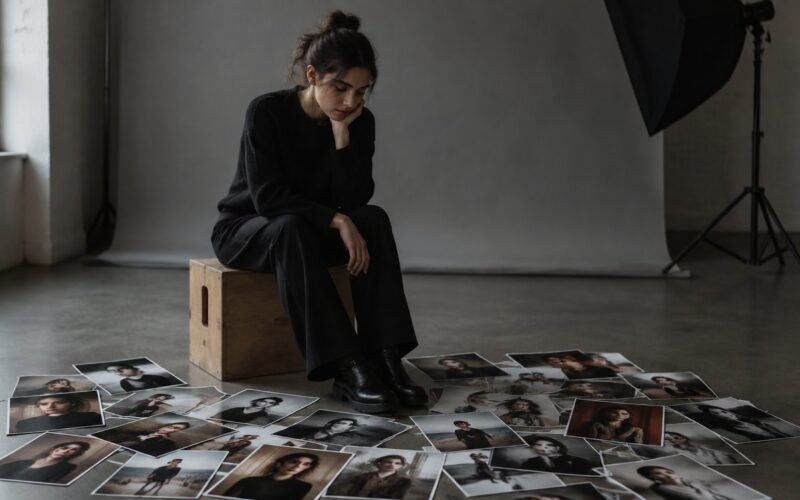
Until then, it would have been easy to think of a portfolio as proof of photographic ability. Can you expose correctly? Compose well? Light a subject? Produce something appealing?
That evening showed me another layer. A portfolio also shows what you recognize as strong work, who you choose to collaborate with, and what you consider ready to put in front of a client.
Kevin wanted her to imagine him photographing her models. He was presenting work he believed demonstrated his ability. She was evaluating it against the needs of her business.
The casting and the photography were being judged together.
That made sense to me. If someone is considering you for a particular kind of assignment, your portfolio has to show them you understand what that assignment demands. Every choice visible in the photographs becomes part of that evidence.
The person in front of the camera changes the image
After more than 20 years photographing models across cities, countries, and cultures, I’ve seen how much the person in front of the lens contributes to the result.
A model’s ability to understand the mood, respond to direction, and bring intention to a gesture can decide whether a concept comes together. The way someone holds their shoulders, uses their hands, or connects with the camera can strengthen or weaken the entire composition.
That matters even more when a shoot needs more than one good frame. A model may need to hold a feeling across a series, move naturally through variations, or make precise adjustments without losing the energy that made the first frame work.
That contribution is a skill, and it deserves to be recognized as one.
It also means choosing a model takes more thought than deciding who’s available or who looks good in a photograph. Different assignments call for different qualities. Someone who excels in glamour may not be the right choice for a particular fashion editorial. A model with a commanding, dramatic presence may need a different approach for an image built on warmth and everyday familiarity.
The photographer has to recognize those distinctions before the shoot, not after.
Learning to see past familiarity
That portfolio review changed how I thought about convenience.
There’s value in working with people you know. Trust makes a session more productive, and an established creative relationship can produce exceptional work. But familiarity becomes a limit when it replaces an honest look at what the concept needs. If you choose someone because they’re nearby, available, or easy to work with, you still have to ask whether they can deliver the performance the photograph requires.
The same scrutiny applies when choosing images for a portfolio. A photograph can mean a lot to you because you remember the effort behind it or enjoyed working with the person in it. A prospective client sees the image without that history. They judge what’s in front of them.
That distance is hard to accept, but it’s useful. Before an image goes into a portfolio, ask:
- Does the model’s performance strengthen the image? Does the expression support the concept? Does the pose feel intentional?
- Does this set match the client I’m showing it to? Work that’s right for one kind of client can be wrong for another.
- Am I keeping this for the client or for my memory of the shoot? If it’s the memory, it belongs in your archive, not your portfolio.
Those questions are part of developing an eye.
Standards require responsibility on both sides
Photographers have to be careful with this lesson.
An emerging model can have extraordinary potential. An experienced model can be wrong for a particular assignment. A casting decision reflects what a project requires. It doesn’t establish anyone’s worth or set the limits of what they can become.
There’s an important place for development, experimentation, and giving new talent a chance. Those sessions are how people grow. The expectations just need to match the purpose of the work.
Photographers also have to bring the preparation and direction they expect from their collaborators. If I want a model to understand my vision, I have to communicate it clearly. If I need a specific performance, I have to give useful direction and recognize when my own approach is falling short.
Choosing capable talent doesn’t remove my responsibility. It gives us a stronger foundation to work from. The best results come when both people understand what they’re creating and bring the ability, attention, and professionalism to execute it.
A lesson that stayed with me
I don’t remember that evening because I enjoyed seeing another photographer disappointed. Kevin was someone I had a good relationship with, and I made the introduction because I wanted it to work out for him. (Making the introduction is only part of it. You can put someone in the room, but you can’t make them ask.)
I remember it because his experience showed me something I needed to understand.
You can have ability and still present a portfolio that fails to show the judgment a particular client needs. You can have a clear vision and choose talent who can’t fully express it. You can produce a technically sound photograph that still falls short as a complete image.
At the time, I came away believing model selection could matter as much as the vision itself. Today I see it as one of the decisions that determines whether the vision survives the trip from idea to finished photograph. The right model doesn’t just fit the vision. They amplify it.
The audience sees what you chose to put into the world. It carries your name, and every visible decision shapes the impression it leaves.
Related: Her Page Is Not Your Shot List and When Good Enough Is Good Enough for the Client.
1 comment
Sign in or join free to leave a comment.