
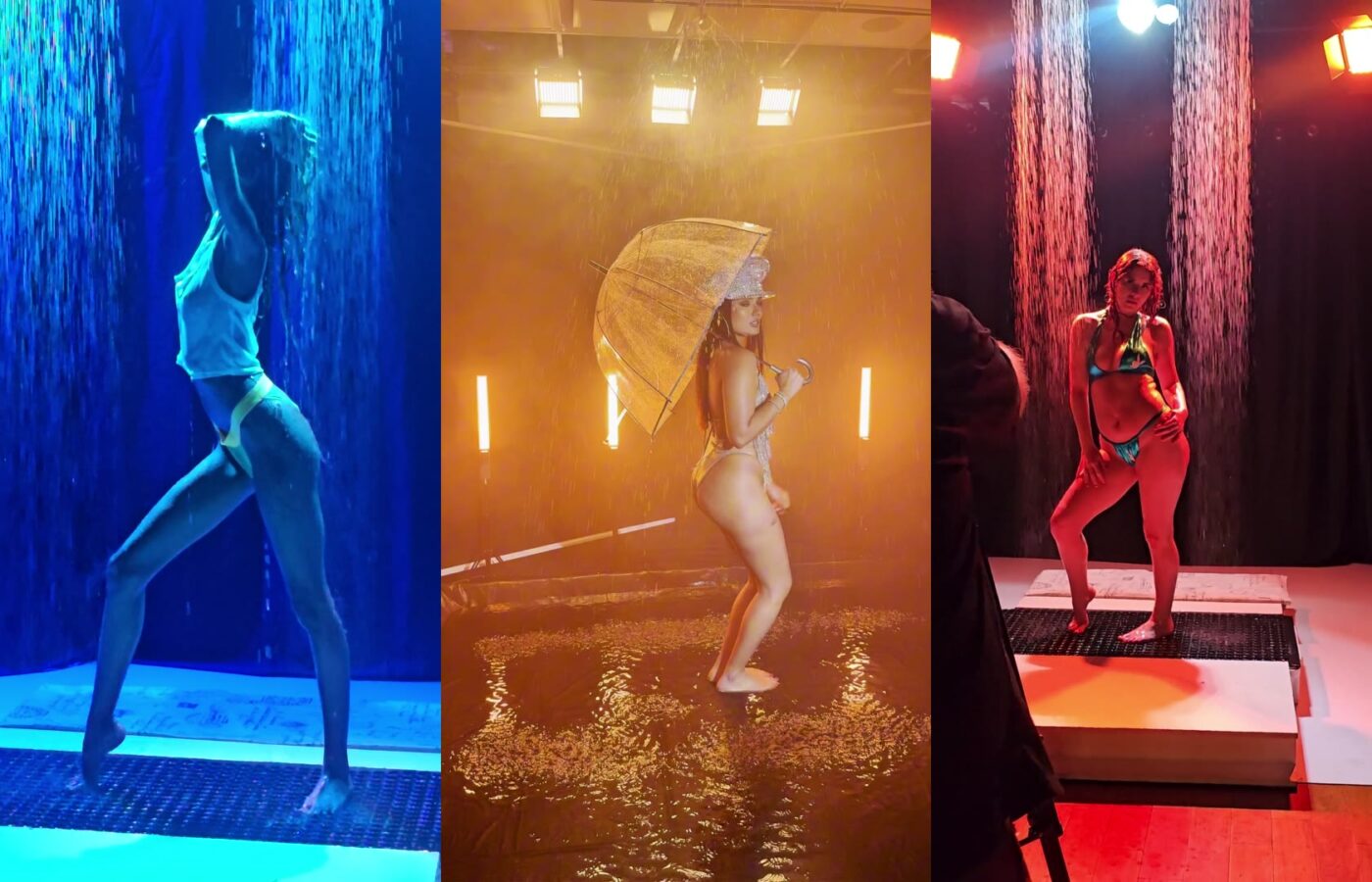
Most rain photography fails before the water is turned on. What it actually takes to pull off a wet set—where the lights go, continuous or strobe, what the shutter is doing—and the options we’ve built into the Rain Room at 360ism Studios.
I’ve watched a lot of rain sets over the years, in our studio and in other people’s, and I’ve noticed something that has nothing to do with the plumbing. Most of the time when a rain shoot looks flat, the water is doing its job. The light isn’t.
The photographs come back and the model is wet, the floor is wet, the hair is slicked, and the rain itself is barely there. A faint grey haze, maybe. A few drops on the shoulders. Nothing that reads as a storm. I’ve seen photographers who market themselves as professionals rent a rain rig, put their key light where they always put it, and produce a picture of a person standing in a damp room.
So before we get to what the Rain Room at 360ism can do, I want to walk through what a rain set actually requires, because the water is the easy part. The light is the whole trick.
You aren’t photographing water. You’re photographing light through water.
A falling drop of water is almost transparent. Point a light at it from the front, from the camera’s side, and the light passes straight through and lands on whatever is behind it. The drop contributes nothing. The camera sees the subject, lit, and a barely visible disturbance in the air.
Put that same light behind the water, pointed back toward the camera at an angle, and everything changes. Now each drop catches the light on its way through and throws a bright specular highlight toward the lens. Thousands of drops do it at once. The rain becomes a curtain of separated bright lines against a dark background, and it wraps the subject in rim light, outlining hair, shoulders, and the edge of the body.
That’s the entire principle, and it’s why the position of the light matters more than the amount of water. Rain lit from the front disappears. Rain lit from behind glows. Everything else in this article is a refinement of that one sentence.
This is a Creative Member article. Join 360ism Network to unlock every premium lesson, download, real-numbers case study, and class recording — plans start at $12/month.
Become a member → · Already a member? Sign in

Sign in or join free to leave a comment.