
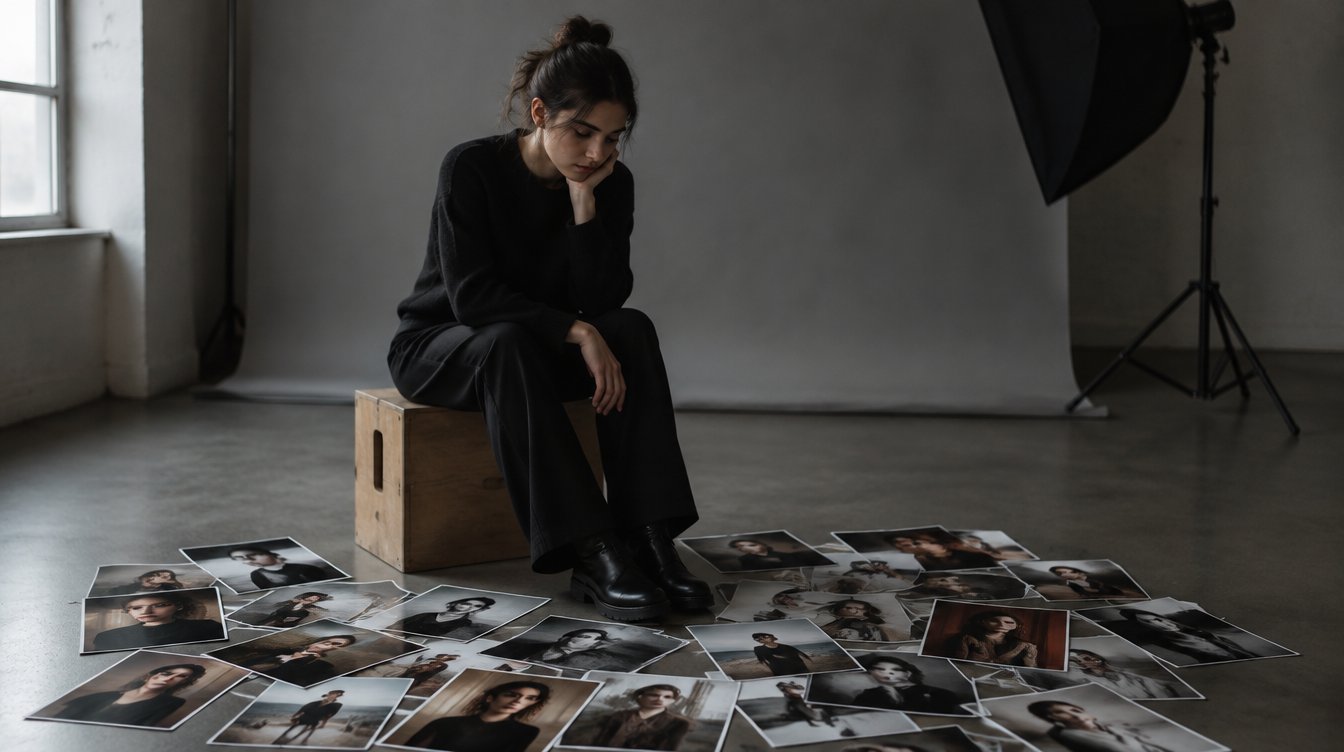
A model can stay busy for years without building anything. Most of the time it isn’t for lack of beauty or effort. It’s because she never understood what the business is built on.
For more than twenty years, I’ve photographed and published a lot of women who called themselves models. If I’m honest, most of them weren’t building a modeling career.
Some were in it to get published. Others were chasing a goal they’d watched someone else reach for, a magazine credit, a certain kind of attention, a certain circle, on the assumption it would put them in front of the right people and eventually lead to money.
I don’t need to name anyone to describe what usually happened next, because it happens all the time. She shoots for a year and a half. Fashion first, then implied, then nudes. She meets photographers, builds a following, and collects a hard drive full of images. Then she burns out, because none of it went anywhere. She never figured out the strategy that would get her in front of the people who could actually move her career.
Everyone in that cycle looks active. Very few stop to ask what the activity is producing.
This isn’t about morality. I’m not here to tell anyone what kind of work is right or wrong. I’m talking about dedication, and about the women who want to call themselves models but get stuck taking pictures that lead nowhere.
What modeling is actually built on
Most of the women I’m describing came in with a master plan. They knew how they wanted to brand themselves, how they wanted to be seen, how they wanted to be respected from behind the camera, and whose approval and cheers they wanted.
What many of them never understood is what the game is built on.
Modeling isn’t built on respect. It isn’t built on approval. It’s built on allure.
There are levels to modeling, and allure runs through all of them.
Product modeling is when you’re selling something else: clothing, jewelry, a car, a drink. The product is the point of the image, but allure is what makes someone stop and look at it. Your job is to make the product more desirable by being next to it.
Charm modeling is when you’re the product. There’s nothing else in the frame to sell. Your presence, your charm, and your ability to hold attention are what the client is paying for, and what the audience is buying.
Most of the women I’m describing are working at the charm level, whether they realize it or not. The models who get somewhere understand that. They treat modeling as a way to sell themselves, and as a way to reach a bigger platform than the one they started on. The ones who get stuck are often still waiting for the camera to deliver respect, as if respect were the job instead of the result of doing the job well.
(I’ve written about this from the glamour side, where the requirement is desire. The same principle runs through every genre.)
The OnlyFans shift
In the last few years, OnlyFans changed the end goal for a lot of these women.
Even someone who’d never thought about modeling could find a photographer willing to shoot her. If the pictures were finished and looked good enough, she could post them and make money. Posing ability and modeling skill weren’t required. The smart ones eventually figured out they didn’t need a photographer at all, or need to be a model, to get paid there.
That’s fine. It’s a hustle, and it’s hers to choose. It isn’t different in kind from deciding to dance at a club. Some women feel they’re above that, so they call it modeling. (I’ve looked at how strip-club economics are reshaping the traveling-model circuit before.)
But it’s a different business with a different goal: money with minimal effort. If that’s the goal, be clear about it, because it calls for different decisions. This article is about the women who want to be models and keep shooting without a plan, until either they quit or they take the OnlyFans route by default.
Copying what looks successful
A lot of stuck models are running someone else’s plan.
I call it “monkey see, monkey do.” A model finds someone who looks successful and starts repeating what she sees: the poses, the styling, the photographers, the events, the way she presents herself online.
Learning from other people is useful. The danger is assuming visibility proves someone has a working business. The woman being copied may still be figuring it out herself. Her photographs tell you almost nothing about her expenses, her paid bookings, her repeat clients, or the opportunities she chased and lost. A busy page isn’t a career, and a follower count isn’t an audience.
When a whole group copies the same surface, they end up repeating the same unproductive choices together.
If you’re going to study another model, study the decisions, not the photos. What skills has she developed? How does she present herself to clients? What relationships has she built? Which of those would actually serve your goal? Her page isn’t your shot list.
“I want to be a model” isn’t a goal
It’s an ambition. To guide decisions, it needs a destination.
A real goal sounds like: preparing submissions for the right agencies, building a portfolio for a specific type of client, developing a base of paying freelance customers, or earning a defined amount from bookings. Each one tells you which opportunities to take and which to pass on.
When the goal stays vague, almost anything feels like progress. A free shoot, a fashion show, a publication credit, another collaboration. The calendar fills up, and the question of where the career is going never gets answered. Getting published can be part of a strategy, but a cover isn’t a career by itself.
Some people model as a creative outlet, and that’s a perfectly good reason. The frustration I’m describing comes from wanting a paying career without ever connecting the creative work to a way of earning.
Every shoot needs a reason to exist
I’ve watched models spend a year or more taking whatever shoots come along while avoiding a deliberate investment in the work they actually need. At the end, they have plenty of photographs and still lack the images that would support where they want to go.
A portfolio should help someone understand your ability and imagine booking you. Every session should have a reason: stronger expressions, better movement, a missing type of image, experience in a particular style, or material for a specific submission. Once you know the reason, you can choose the photographer, styling, and location that serve it.
That sometimes means spending money. Being professional includes budgeting for your own development when there’s a clear need and a credible person who can meet it. A model who won’t invest in the work her goal requires shouldn’t be surprised when casual collaborations never produce it.
The amount isn’t the point, though. An expensive shoot can serve the wrong goal. Before you pay anyone, know what you need, what you’ll receive, and why that person is the right one to provide it. Any offer built on a promise of guaranteed bookings deserves hard scrutiny.
The same thinking applies to shooting for free. TFP can give you practice, stronger images, a useful relationship, or a creative experience worth having. After a long stretch of it, review the results. Have the images improved? Can you show skills you couldn’t before? Are you reaching the right clients? Are you easier to find, evaluate, or book? If the answers are unclear, more of the same won’t clear them up.
Five questions before your next shoot
- What kind of modeling work am I pursuing?
- Who could realistically hire me for it?
- What do those people need to see to believe I can do it?
- What specific gap will this shoot close?
- What will I do with the images afterward?
The last one matters most. Images need a use: a submission, a portfolio refresh, a new service, or a conversation with a potential client. Decide the use before the session, and the session has a much better chance of being worth it.
At some point, outside feedback becomes necessary too. You may feel your portfolio is ready while the people who know your target market see the gaps. Being willing to hear that, and to judge whether the person saying it knows what they’re talking about, can save you another year of the same decisions.
Give it a direction
None of this guarantees an outcome. Money, location, access, responsibilities at home, and discrimination all shape who gets opportunities, and rejection alone doesn’t prove someone lacked a plan.
But a plan gives you a way to read what’s happening, adjust, and decide where your effort belongs. Beauty and enthusiasm deserve that much. After twenty years of watching women enter this field, I’d like to see more of them give those qualities a real chance to become something that lasts.
Before another year goes by, take an honest look at what your work is building. Define the goal. Learn who hires for it. Understand that what they’re buying is allure. Then make the next shoot part of the plan.
Related: The Standard in Front of the Lens, on portfolio judgment from the photographer’s side, and After the Spotlight, on what a model builds while the attention lasts.

Sign in or join free to leave a comment.