
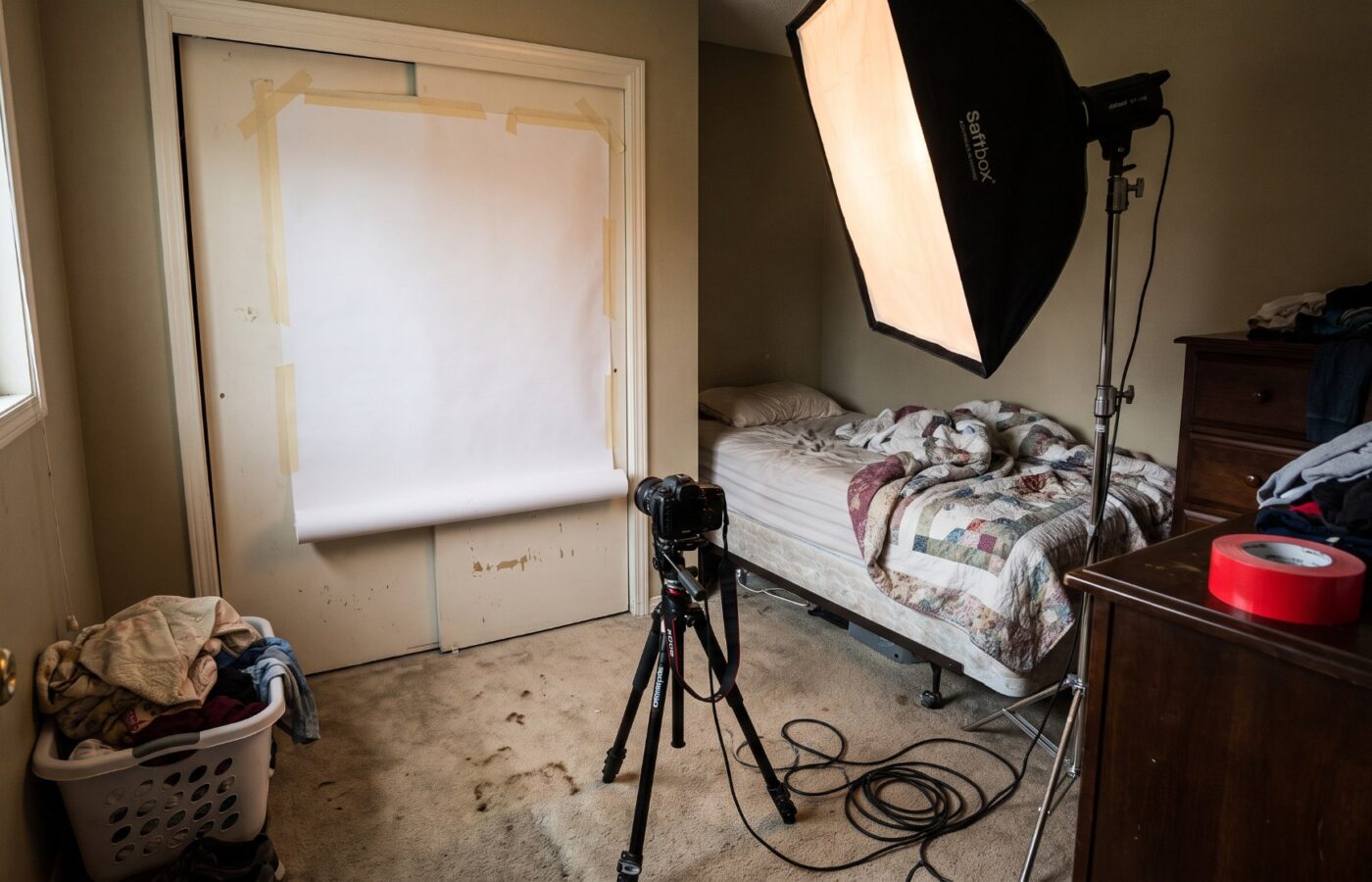
A closet can make a headshot. It can’t make a studio. Why “studio quality without a studio” is the most misleading promise in photography right now—and what a dedicated space actually gives a photographer that a spare room never will.
I should say up front that I own studios. I rent them to photographers, videographers, and podcasters in Richmond, and I’ve spent a considerable part of the last twenty years building rooms specifically so that production work could be done properly. So when I tell you that my number one pet peeve in photography is people selling the idea that you don’t need a studio, you’re entitled to hear that with some suspicion. Of course the man renting studios thinks you need a studio.
Fine. Hold that thought, and then judge the argument on what a room physically does to light, because none of what follows depends on my invoice. It depends on distance.
Here’s the pet peeve, stated precisely. There’s a whole genre of photographer, and a whole genre of course, preset pack, and YouTube channel, built on the claim that a professional studio adds nothing. Shoot in your closet. Shoot in your bedroom. Shoot in the garage with a roll of paper taped to the door. “Studio-quality images, no studio required.” And the frustrating part is that the photographs they show to prove it are usually fine. That’s what makes the claim work, and that’s what makes it misleading.
The claim is true for exactly one kind of picture
Let’s give the closet its due. A tight headshot on a seamless is the easiest lighting problem in the entire craft. The working distance is short. One key light and a reflector will do it. Put the subject a couple of feet off the paper and the light falls off before it gets there, so the background separates itself without any help. Shoot at 85 or 105 and the walls disappear. A careful person can produce a clean, commercial, entirely professional headshot in a space the size of a walk-in closet, and plenty of them do.
So the small-space crowd isn’t lying about their pictures. They’re making a capability claim, and the capability claim is what’s wrong. “You don’t need a studio” is demonstrated with the one category of image that a small room can handle, and then generalized to the whole profession. The demonstration proves the closet can do the closet’s job. It proves nothing about anything else.
I’ve watched photographers who came up entirely in that world walk into a real room for the first time and freeze, not because they lack talent but because they’ve never had to make the decisions that a room forces. Where does the subject stand relative to the background? Where does the camera go? How far away is the key, and what happens to the shadow when I move it? In an eight-by-ten bedroom those questions were answered for them by the walls. They never learned that the answers were choices.
Space is a lighting variable, not a real-estate flex
The physics here is boring and unarguable, which is why I prefer it to opinions.
Light falls off with the square of distance. Move a light from four feet to eight feet and the subject receives roughly a quarter of the light. That same rule governs the background. Put a subject four feet in front of a backdrop and the key that lights her face lights the paper almost as brightly. Put her twelve feet in front of it and the paper goes dark on its own, and now you can light it separately, to whatever tone you want, with a light that isn’t touching her at all. That’s the difference between a background you control and a background you tolerate.
In an eight-foot room, the twelve-foot option doesn’t exist. You get four feet, maybe five, and every other decision has to be made inside that constraint. You can still make a good picture. You can’t make the range of pictures.
Working distance does the same thing to perspective. The camera position, not the lens, determines how a face and body render against their surroundings. The lens just crops what the position gives you. If you want the compression and flattering geometry of a long lens on a full-length figure, you need floor behind the camera, typically twenty feet or more. A small room hands you a wide lens and a close camera and calls it the same shot. It isn’t. It’s a different drawing of the same person, and usually the less flattering one.
Then there’s the room itself as a light source. Walls four feet from your subject aren’t neutral. They’re enormous white reflectors that bounce your key back into the shadow side whether you want it there or not. Contrast that you carefully built with a grid or a flag gets filled by the paint. A dedicated studio gives you distance from the walls, dark surfaces where you need them, and enough air around the subject that the only light hitting her is the light you placed. Control isn’t a mood. It’s the number of feet between the subject and the nearest surface you didn’t choose.
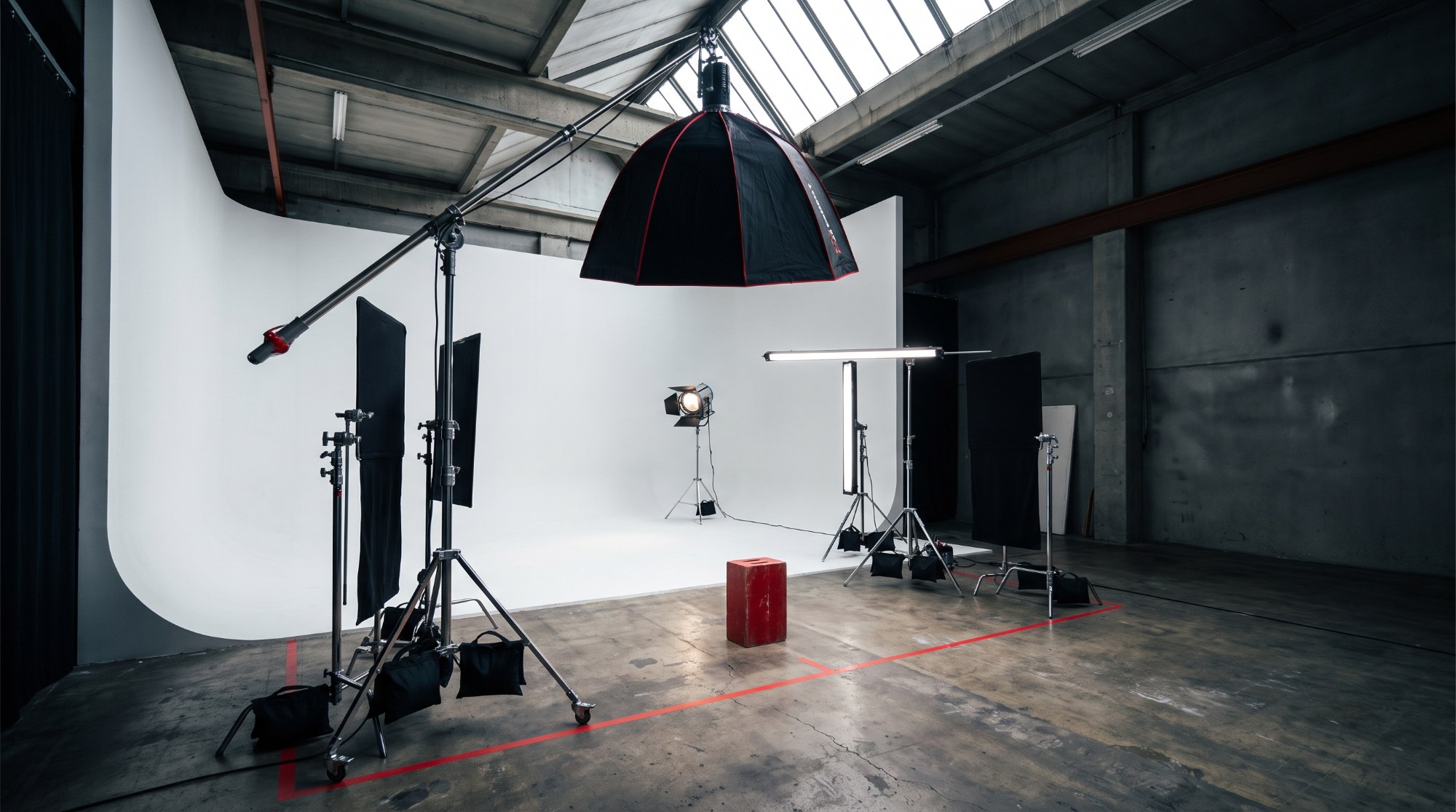
The production menu is what the small room quietly removes
Look past the single frame and count what a small space takes off the table.
You can’t put a light overhead on a boom, because there’s no ceiling height and no floor for the stand. You can’t feather a large source across two or three people, because the source can’t get far enough away to cover them evenly. You can’t light a full-length figure from head to toe without hot spots, because a six-foot softbox needs room to breathe. You can’t backlight cleanly, because there’s no depth to hide a light behind the subject. You can’t shoot a group. You can’t shoot movement, a dancer, a garment that needs to swing, a subject who needs to walk toward the camera. You can’t build a set, and you definitely can’t build a second set while the first is still standing so that a client moves from look one to look two without a twenty-minute reset.
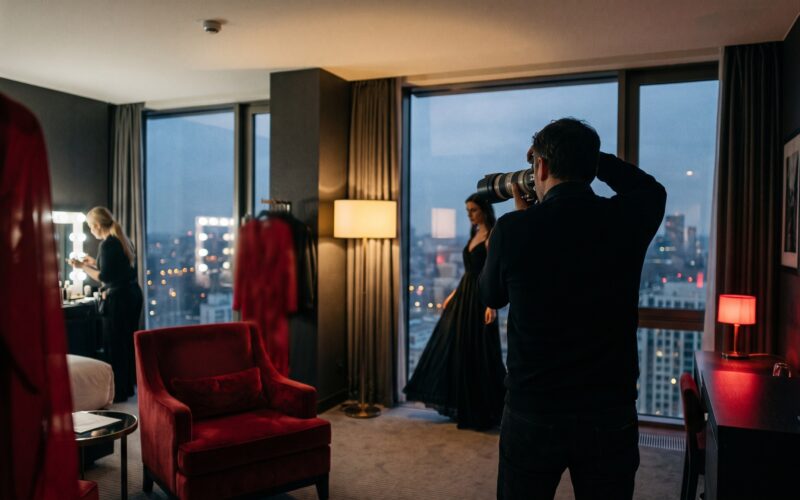
And you can’t fit the people. A real production day has a client in the room, a stylist, a makeup artist, a rolling rack, a table for the laptop, sometimes a video crew running alongside stills. Those people need to stand somewhere that isn’t in the frame and isn’t in the light. The photographer needs to move around the subject without asking three people to step into the hallway. A bedroom can’t hold a production; it can hold a photographer and a subject and the hope that nobody else shows up.
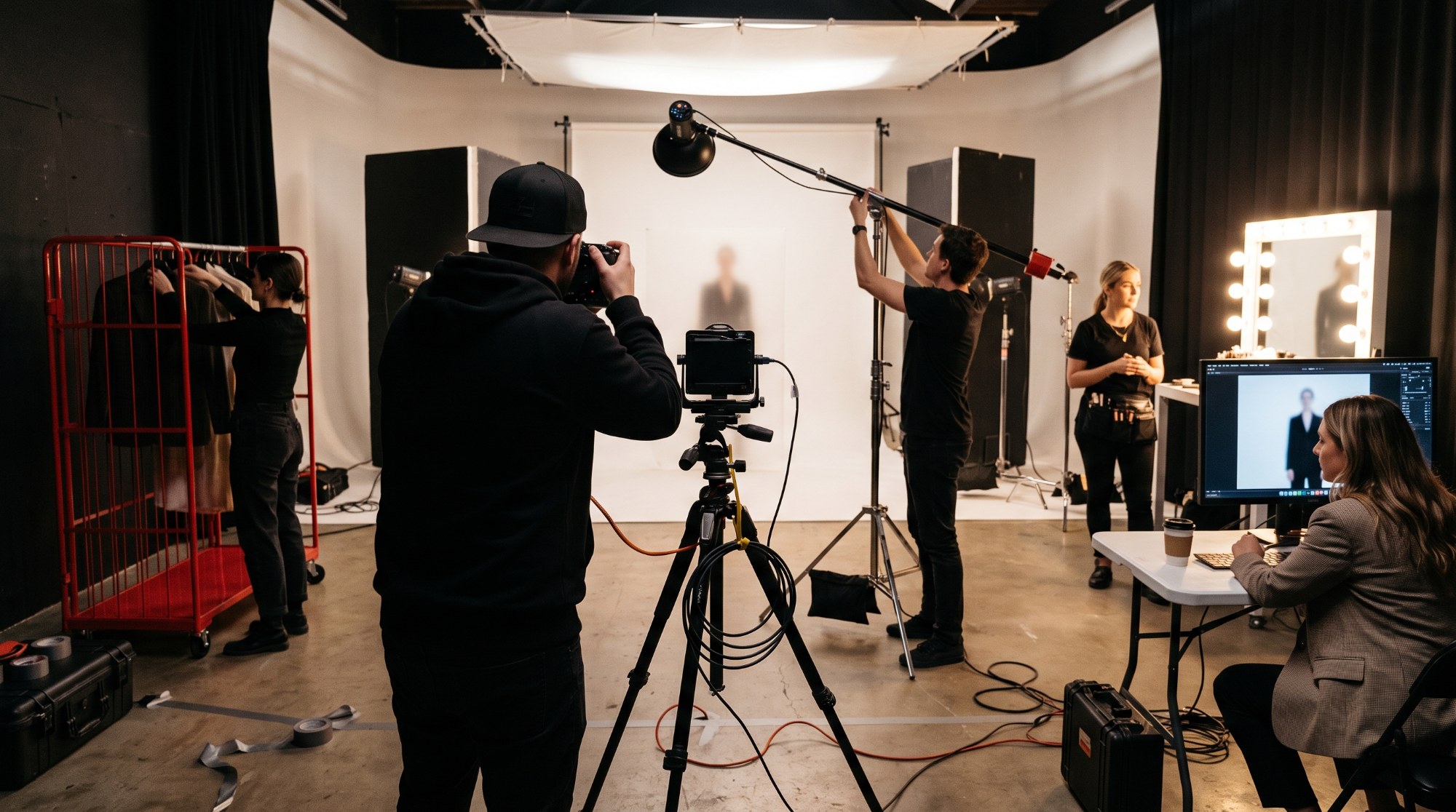
None of that’s exotic. It’s the ordinary vocabulary of commercial, editorial, fashion, and even serious portrait work. So when someone says a studio adds nothing, what they’re really saying is that they’ve never been asked to do any of it, and they’ve built a business model on the assumption that their clients won’t ask either.
A finished photograph hides the setups that were impossible
This is the part that makes the marketing work, and it’s worth understanding why.
A photograph is evidence of what was possible. It’s silent about what wasn’t. When a closet photographer posts a strong headshot, the image can’t tell you that the full-length version was never an option, that the second look was skipped because the backdrop couldn’t change, that the client asked for a three-quarter shot with a lit background and was told it “wasn’t the vibe.” The picture only shows the setup that fit the room. Everything the room ruled out simply doesn’t appear.
Clients can’t see that absence. New photographers can’t either. So the closet headshot circulates as proof of equivalence, and nobody in the audience is in a position to notice that it’s proof of one narrow thing. That’s the mechanism of the misleading claim. It isn’t a lie in the picture. It’s a lie in what the picture is used to stand for.
Why this is more than a technical quibble
If it were just a physics disagreement, I’d let it go. What bothers me is what the claim does to the market, on both sides.
On the photographer’s side, “you don’t need a studio” trains people to price like hobbyists. If the whole craft fits in a bedroom, then the only cost of doing business is a camera and a light, and the rate follows. Those photographers then hit a ceiling they can’t see. They can’t take the jobs that need the production menu, so they stay in the headshot economy competing on price against everyone else who also fits in a bedroom. The claim that was supposed to free them from overhead is actually the thing capping their income.
On the client’s side, it trains businesses and models to expect production-level results at closet prices. A brand that has seen “studio quality” delivered from someone’s spare room for a hundred and fifty dollars doesn’t understand why the photographer who quotes a studio rental, a stylist, and a full day is asking for two thousand. They’re being compared as if they were the same product. They aren’t. One of them can do one setup well. The other can do whatever the brief requires. But the marketing has flattened the difference, and the person who gets hurt is the one who invested in being able to do the work.
That’s the real cost of the small-space pitch. It doesn’t just mislead beginners about lighting. It devalues everything above it.
What a studio is actually for
Let me describe what a dedicated space does, in plain terms, because the word “studio” has been so stretched by people taping paper to garage doors that it’s lost its meaning.
A studio is depth. It’s the distance that lets you place a subject far from the background and light the two independently. It’s floor behind the camera for a long lens on a full body. It’s ceiling height for overhead light and the room to raise a large source high enough to look like it came from the sky rather than from a lamp.
A studio is controlled surfaces. Dark walls or distance from the walls so the only light in the shot is the light you placed. A cyclorama or a paper roll wide enough for movement and groups. A floor you can put a set on.
A studio is infrastructure. Power you can trust. Stands and booms and modifiers already in the room. Somewhere for makeup to work with real light. Somewhere for a client to sit and see the monitor. Somewhere for the wardrobe. A door that closes. A schedule that belongs to you for the hours you booked.
And a studio is repeatability. The same room, the same distances, the same light, so that a client’s second shoot matches the first, so that a catalog shot in March matches the one shot in October, so that the photographer’s job is to make decisions rather than to fight the room.
None of that’s about prestige. It’s about the size of the menu you can offer someone who hires you.
What I’d tell a photographer who works out of a small room
Nothing in this is a case against starting small. Almost everyone should. Learn a single light in a small room until you can predict what it will do before you turn it on. Master the headshot; it’s the most consistently paid work in the business, and doing it well is a real skill. Build a client list. Buy the second light when the first one is paying for itself.
Just be honest about what you’re selling. If the room supports headshots and tight portraits, sell headshots and tight portraits, price them well, and say so. Don’t call it studio work. When a client asks for something the room can’t do, don’t talk them out of it; that’s the moment to rent the space, take the job, and step up a rung. The photographers I see grow are the ones who treat the studio as the next tool, not as an insult to their bedroom.
And when a course, a workshop, or a well-lit influencer tells you that a dedicated space adds nothing, ask them to show you the full-length shot with a separately lit background, the two-person setup with even coverage, and the second set built while the first was still standing. If they can’t, they’re not showing you that studios are unnecessary. They’re showing you the edge of their room.
The honest version of the claim
The true statement is this: you can make a professional photograph in a small space. The false statement is that a small space can do what a studio does. The people selling the second one are using the first one as proof, and the audience can’t tell the difference because a finished picture never shows what was impossible.
A ten-by-eight room can make a headshot. Some of the best headshots I’ve seen came out of rooms like that. It can’t give you the working distance, the lighting control, the room to build, or the ability to execute more than one tightly constrained setup. That’s not a knock on the photographer. It’s a description of the room.
Call it what it is, and charge accordingly.
1 comment
Sign in or join free to leave a comment.