

Model: Maliah Mayara · Photography by Daring Leaderman
There’s a point where a model event stops being about modeling—even if everyone in the room still has a camera.
I was recently approached by a photographer who wanted to use my studio to bring in a few traveling models for workshops and group shoots. On the surface, the request sounded no different from dozens of others. He knew women who were willing to travel, he wanted to organize something of his own, and he needed a space to host it.
I told him that would be fine.
Then he showed me a video of one of the women he was considering. In the video, she wasn’t posing nude, creating an implied image, or participating in a fine-art figure study. She was performing an explicit sexual act outdoors while he filmed her.
That was when I realized we weren’t talking about the same kind of event.
My concern wasn’t that some models also create adult content. That’s neither new nor surprising. Models may also work as dancers, subscription-content creators, or adult performers. Some run successful businesses producing explicit content on their own terms, under their own names, for an audience that knows exactly what it’s buying. I’m not interested in policing what consenting adults choose to create elsewhere.
What concerned me was the use of the word workshop. He and I had used the same word while picturing two very different rooms.
The camera doesn’t decide the category

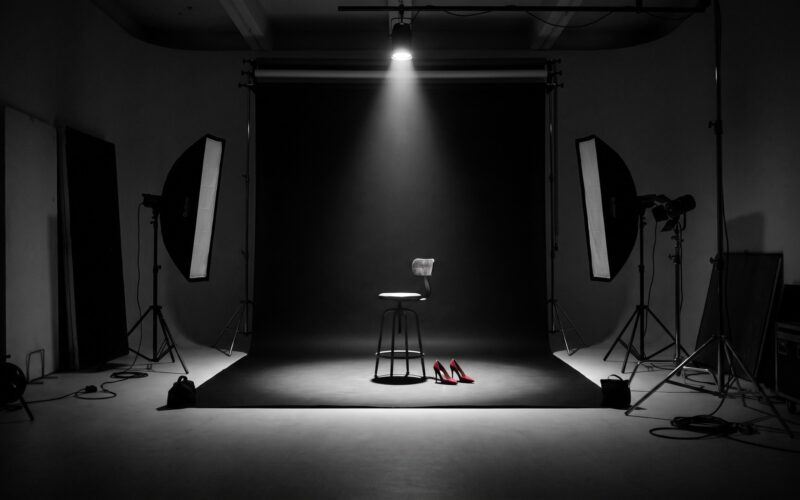
A styled session in this studio: a closed set, a signed release naming the genre, and one declared shooter. The image is the purpose of the session.
I’ve photographed fashion, glamour, swimsuit, lingerie, boudoir, implied nude, and fine-art nude. Some of that work is sensual. Some of it’s provocative or intimate. None of those qualities automatically turns a photography session into a sexual performance.
A model can be completely nude and still be participating in a legitimate, professional production. The work may explore shape, light, movement, vulnerability, or the human body itself. She’s using her expression, pose, and physical control to help create a photograph. The image is the reason everyone is there.
An explicit performance is different. The camera may still be recording, but the act—not the photograph—has become the main attraction. That content may be intended for sale, distribution, or promotion to future customers. There’s a market for it, and adults are free to participate in that market. But it shouldn’t be presented as model photography simply because someone pressed Record.
Wardrobe doesn’t settle the question. Nudity doesn’t settle it either. The purpose of the session, the service being offered, and the expectations of the people in the room do.
When a workshop becomes a sales floor
One part of this situation needs to be stated clearly because getting it backward would change the meaning of the article.
I’m not describing photographers pressuring women to perform sexual acts. Based on what was described to me, the offers were coming from the women themselves. They were approaching photographers and letting them know what they would do for additional money. In that exchange, the photographers were potential customers.
That matters. A woman making a deliberate business decision isn’t automatically a victim, and I don’t want to erase her agency simply because I disagree with where the transaction is taking place.
At the same time, agency doesn’t determine the category of the event. A room full of photographers is also a concentrated group of potential buyers. They have already demonstrated an interest in photographing women, many are accustomed to paying for access, and nearly everyone is carrying a camera. If explicit services are being offered throughout the day, the room can easily become a customer-acquisition system for adult performances—even when the flyer still calls it a workshop.
The organizer may not be selling those services directly. He may not even know about every private offer being made. But once that activity becomes part of what participants can reasonably expect to encounter, it begins to shape the identity and reputation of the event.
Photography is no longer the whole product. It may have become the cover story.
The damage caused by a blurred label
The biggest problem with a hybrid event isn’t simply that adult content exists inside it. The problem is that people can enter the same room under the same label while expecting completely different experiences.
A photographer may arrive believing he paid for a creative workshop: access to talent, sets, lighting, instruction, and time to make strong images. If explicit offers begin arriving throughout the day, he’s no longer being treated only as a photographer. He has become a customer with a camera.
That experience also changes how some photographers approach the next model. After seeing boundaries treated as negotiable add-ons, a photographer may begin to assume that nude is only the opening price for something more explicit. A model who came to create fashion, boudoir, or fine-art nude images then has to defend a boundary that should never have been questioned. She’s forced to manage expectations created by transactions she had nothing to do with.
Over time, this pulls attention away from ability. Models are valued less for their look, posing skill, professionalism, or creative range and more for the amount of access they will sell. That can generate money quickly, but it creates a market with no real floor. Someone else can always promise more access for less.
The effects don’t stop with models. Photographers who came to create are treated as sales leads. Organizers develop reputations they may not have intended to build. Studios can find their names attached to activities they never approved. Even experienced adult performers are placed at risk, because their work also depends on clear pricing, controlled distribution, and boundaries that everyone agrees to respect.
None of this requires shaming adult workers or pretending the adult-content market doesn’t exist. It requires people to be honest about which business is taking place.
Consent is bigger than a private agreement
It isn’t enough to say that one model and one photographer agreed to a scene.
Everyone in the room should know what kind of event they have entered, what may happen around them, who’s allowed to record, and where those recordings may appear. A private agreement between two people doesn’t automatically cover everyone who may be seen or heard in the background.
A conventional group shoot already needs clear rules about releases, boundaries, posting, and usage. Once explicit scenes are introduced, those concerns become far more serious. Phones are cameras. Glasses can be cameras. A photographer recording his own session can accidentally capture another scene behind him. A model may consent to one person filming her without ever agreeing to have a dozen other people leave with copies.
A model once told me that camera-equipped glasses had been prohibited at certain events for this reason. I haven’t independently verified that policy, so I won’t present it as fact. But the concern behind it’s entirely credible. Once sexual performances are happening inside a photography event, the organizer is managing privacy, recording, consent, and distribution at a level that an ordinary model release was never designed to cover.
By then, the event has already become a different kind of production, whether anyone has admitted it or not.
The studio can’t be the last to know
When I first heard the word workshop, I understood it through the world in which I operate. I thought about lighting, sets, posing, instruction, releases, schedules, and studio access.
After seeing the video, I understood that we hadn’t been using the same dictionary.
Permission to bring models into my studio for a workshop isn’t permission to stage or market sexual performances, sell explicit add-ons, or quietly turn the space into an adult-content venue. A studio owner has the right—and the responsibility—to know what is being hosted. So does every person whose name, image, or reputation may become attached to it.
This isn’t a fear of nudity. My studio has hosted nude photography and will continue to welcome approved fine-art, boudoir, lingerie, implied, and other mature work under controlled conditions.
But a model shoot and an adult-performance event require different disclosures, recording rules, safeguards, and expectations. A venue shouldn’t discover which one it hosted after the doors are closed and the cameras are already running.
The standard for my studio
The events I host are designed to get models paid for modeling and to give photographers structured access to talented people worth photographing.
That includes fashion, beauty, lifestyle, swimsuit, lingerie, boudoir, implied, and fine-art nude work. It includes sensual imagery and mature themes. It also includes models who may create adult content elsewhere, on their own platforms and on their own terms.
What it doesn’t include is models soliciting photographers as customers for sexual performances or explicit add-ons. It also doesn’t include photographers soliciting models for those services. The direction of the offer doesn’t change the standard.
If I wanted to produce an adult-content event, I would call it that and build the screening process, venue rules, recording policy, and business structure that such an event requires. That isn’t what I’m building.
I want a model to walk into the studio knowing she’s being hired for her talent and that her boundaries won’t become a negotiation once the session begins. I want photographers to know they’re paying for talent, direction, and production value—not entering a sales floor. And I want the studio to remain a place where people can create bold, sensual, and nude work without the space being treated as an extension of the adult market.
That isn’t prudishness. It’s professional clarity.
Make the line visible
There’s nothing inherently dishonest about an adult-content event that clearly identifies itself. If the models know, the photographers know, the venue knows, the recording rules are enforced, and everyone has agreed to the same kind of production, adults can decide for themselves whether to participate.
The dishonest version is the hybrid event that borrows the language and credibility of professional photography while quietly operating on adult access.
Calling something a workshop doesn’t make it one. Calling someone a model doesn’t make every service she offers modeling. Holding a camera doesn’t turn everything in front of it into photography.
The label matters because the label shapes what people believe they’re agreeing to when they enter the room.
Before organizing an event, write one paragraph explaining exactly what a participant is buying. State what is included, what is prohibited, who may record, and where the resulting images or video may appear. Then hand that paragraph to a model and a photographer and ask each of them what they expect to happen.
If their answers don’t match yours—or each other’s—the event isn’t ready to be sold.
That paragraph now exists for my studio as the Studio Event Standard, and it governs anything hosted here. Any organizer is welcome to use it as a starting point.
The problem was never nudity. The problem was one business operating inside the language of another.
Sign in or join free to leave a comment.